
The Complete SEO Guide for Businesses in India (2026)
Somewhere in your city, right now, a customer is typing exactly what you sell into Google. Within seconds, they'll call whichever business shows up first.
If that isn't you, you never even find out you lost the sale.
That's the quiet problem for many Indian businesses. The product is good and customers are happy, but at the moment of search, a competitor appears and you don't. Every week, they collect enquiries that could have been yours. Ads can plug the gap, but only while you keep paying.
This SEO guide for businesses shows you how to close that gap, one practical step at a time.
- Author
- Rapzter Digital
- Reading
- 18 min read
The short answer
SEO (search engine optimization) is the work of making your website easy for Google and AI search tools to find, understand and trust, so it appears when people search for what you offer. With about 1.04 billion people online in India, it's how businesses earn steady, relevant enquiries without paying for every click.
Keep these
What to remember
- Google has to crawl a page, store it, and then decide it is a good answer. A page nobody links to, and that is missing from the sitemap, may never be found.
- SEO, answer engine optimization, and generative engine optimization overlap. Google says no extra schema is required to be considered for AI Overviews.
- Most businesses see meaningful movement in three to six months. A promise of page one by a fixed date is a reason to walk away.
What Is SEO and How Does It Work?
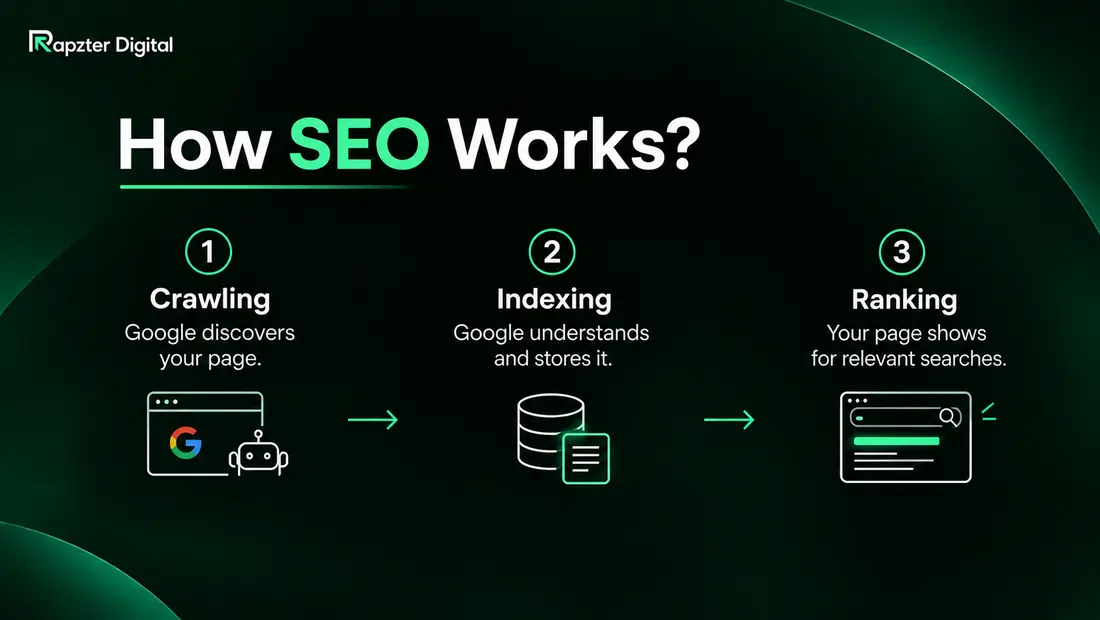
Think of Google as a librarian in a library that never closes and gets millions of new books every day. SEO is how you make sure your book is on the shelf, labelled clearly, and handed over first when someone asks for it.
Google describes how SEO works on its side in three stages, explained in its How Search Works guide.
1. Crawling: Google finds your pages.
Automated bots called crawlers discover pages by following links and reading sitemaps. If nothing links to a page and it isn't in your sitemap, Google may never find it.
2. Indexing: Google understands and stores them.
Google reads each page and works out what it's about. Thin, duplicate or blocked pages can be left out completely. Google says plainly that indexing isn't guaranteed.
3. Ranking: Google picks the best answers.
When someone searches, Google pulls matching pages from its index and orders them by relevance and quality. It also considers the searcher's location, language and device. That's why "AC repair near me" shows different results in Andheri and in Thane.
A quick example (illustrative). A dental clinic in Pune publishes a page on root canal treatment. Google crawls it through a link on the homepage, indexes it as a page about root canal treatment in Pune, then decides whether it deserves to show for "root canal cost in Pune." Helpful content, a fast page and genuine patient reviews all improve its chances.
The 3 Types of SEO: Technical, On-Page and Off-Page
Every SEO task falls into one of three buckets. Most businesses need all three, just in different amounts. The examples below are illustrative.
Technical SEO
It makes sure Google can crawl, load and understand your site. It covers site speed, mobile usability, sitemaps, broken links and HTTPS security.
Example: A Jaipur furniture store's product pages take eight seconds to load on mobile. Compressing images and removing heavy scripts makes them quicker for shoppers and easier for Google to process.
On-page SEO
It improves what sits on each page: titles, headings, content, images and internal links. It tells readers and Google exactly what the page offers.
Example: An Ahmedabad CA firm's services page is titled "Home | Services." Renaming it "GST Registration and Filing Services in Ahmedabad" and answering common client questions on the page makes its purpose obvious.
Off-page SEO
Off-page SEO builds trust from outside your website, mainly through links and mentions on other reputable sites.
Example: A Bengaluru SaaS startup shares original survey data with an industry publication. The article links back to the startup's site, which signals to Google that others consider the brand credible.
Why SEO Matters for Indian Businesses in 2026
Your next customer probably finds you on a phone. India had 1.10 billion active mobile connections in late 2026, according to DataReportal's Digital 2027: India report. If your site is slow or awkward on a small screen, you lose them before they read a word.
Here's why SEO for Indian businesses matters more each year.
- Competition is a click away. Whether you run a bakery in Indore or a SaaS company in Noida, buyers compare three or four options before they call anyone. Showing up during that research is half the battle.
- Ads get more expensive as more businesses bid. Google Ads works like an auction, so crowded categories push click prices up. SEO traffic doesn't charge you per visit.
- Rankings keep working. A page that ranks today can bring enquiries for months, long after you've stopped spending on it.
- Search is becoming AI-powered. Google launched AI Mode in India in 2025 and says AI Overviews are used by over 1.5 billion people every month. Google also says Indians form its largest user base for voice and visual search worldwide.
The takeaway: a sound SEO strategy for India now has to work for typed searches, spoken questions and AI-generated answers.
How Is SEO Changing With AI Overviews and ChatGPT?
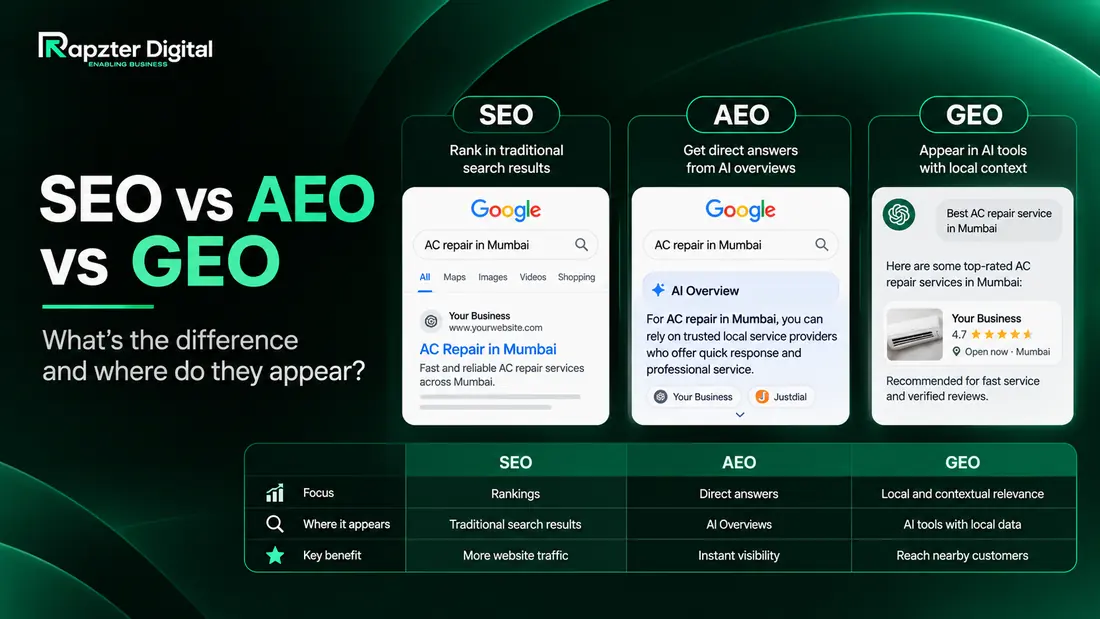
When someone asks Google or ChatGPT a question today, they often get a written answer first and a list of links second. That changes what "visibility" means.
There are now three related goals, and they overlap more than people think.
SEO, AEO and GEO compared
| Traditional SEO | AEO (Answer Engine Optimization) | GEO (Generative Engine Optimization) | |
|---|---|---|---|
| Goal | Rank web pages in search results | Be the direct answer to a question | Get cited or mentioned in AI-generated answers |
| Where it shows | Google's blue links | Featured snippets, People Also Ask, voice answers | Google AI Overviews, AI Mode, ChatGPT, Perplexity |
| What helps most | Relevant content, technical health, backlinks | Clear question-and-answer formatting | Accurate facts, consistent brand details, mentions on trusted sites |
| How you measure it | Rankings, clicks, organic traffic | Snippet wins, impressions | AI citations and brand mentions (partly manual today) |
You don't need a separate rulebook. Google's own guidance on AI features says there are no extra requirements or special schema needed to appear in AI Overviews or AI Mode. A page must be indexed and eligible to show a snippet, and nothing is guaranteed.
- Answer common questions directly in the first two lines of a section.
- Use specific facts, numbers and examples with sources.
- Keep your business name, address, services and prices consistent everywhere online.
- Earn mentions on credible Indian publications and industry sites.
- Keep your Google Business Profile complete and current.
Rapzter's own SEO work treats AI search readiness as part of regular SEO: schema markup, FAQ content and consistent brand details. For the full playbook, read our guide on what GEO is and how it differs from SEO.
The 7-Step SEO Guide for Businesses: The Process
This is the practical core of this SEO guide for businesses. Follow the steps in order, because each one builds on the last.
Step 1. Conduct an SEO Audit
An SEO audit shows what's stopping your site from ranking before you spend money on new content.
What to check: pages Google has indexed, crawl errors, broken links, duplicate pages, slow pages, mobile problems and missing titles.
How: Verify your site in Google Search Console and open the Pages report. Run a crawl with Screaming Frog (free up to 500 URLs) and test key pages in PageSpeed Insights.
- Search Console and Google Analytics 4 connected
- Important pages indexed
- No broken links or redirect chains
- Top 10 pages tested for mobile speed
Step 2. Perform Keyword Research Based on Search Intent
Keywords are the words customers type. Intent is why they type them. Match both, or the right page ranks for the wrong reason.
Search intent
| Intent | What the searcher wants | Example |
|---|---|---|
| Informational | To learn | "how to file GST returns" |
| Commercial | To compare | "best CA firm in Pune for startups" |
| Transactional | To buy or book | "GST registration services online" |
| Navigational | A specific brand | "ClearTax login" |
Focus on long-tail keywords, longer phrases like "interior designer for 2BHK in Thane." They get fewer searches but convert far better because the buyer knows what they want.
Then do keyword mapping: assign one main keyword to one page so your pages don't compete with each other.
Tools: Google Keyword Planner, Search Console's Queries report, Semrush or Ahrefs, and Google's "People also ask" box.
Step 3. Fix Site Structure and Technical SEO
A clear structure helps visitors and Google find everything in two or three clicks: Home, then Services, then an individual service page.
Fix these first.
Core Web Vitals: aim for LCP under 2.5 seconds, INP under 200 milliseconds and CLS under 0.1, as defined by Google's web.dev.
Mobile usability: buttons easy to tap, text readable without zooming.
XML sitemap: submitted in Search Console.
robots.txt: not blocking important pages by mistake.
SEO-friendly URLs: short and readable, like /services/gst-registration instead of /page?id=4821.
HTTPS on every page.
Rapzter's experience, as stated on its SEO service page, is that technical fixes can show results within weeks, which makes this the quickest win for most sites.
Step 4. Optimise Your Website Pages
On-page SEO tells Google and readers exactly what each page offers.
- Title tag with the main keyword near the start, around 50 to 60 characters.
- Meta description that sells the click in about 150 characters.
- One H1, with clear H2s and H3s below it.
- Content that fully answers the searcher's question.
- Compressed images with descriptive alt text. ("stainless steel modular kitchen in Pune" beats "IMG_204")
- Internal links to related services and blogs.
These length guides are sensible defaults rather than Google rules. Google may rewrite titles and descriptions anyway.
Step 5. Create Helpful Content and Topic Clusters
Publishing random blogs rarely builds rankings. Topic clusters do.
A cluster has one pillar page covering a broad topic, plus several supporting blogs on specific questions. Each supporting blog links to the pillar, and the pillar links back.
Example (illustrative): A Kochi travel company builds a pillar on "Kerala tour packages," with supporting blogs on "best time to visit Munnar," "Alleppey houseboat cost" and "Kerala itinerary for 5 days." Together, they show Google real depth on Kerala travel.
Write for people first. Share first-hand experience, real prices and local details that generic content can't copy.
Step 6. Improve Local SEO
If customers visit you or you serve specific cities, local SEO often brings the fastest enquiries. Set up and verify your Google Business Profile, use city-based keywords, collect reviews and keep your contact details identical everywhere. The full local checklist is in the next section.
Step 7. Build Website Authority
Google trusts sites that other trusted sites talk about. That's authority.
- Get featured in relevant industry publications and Indian business media.
- Share original data, such as a customer survey, that others want to cite.
- Partner with suppliers, associations or event organisers who can link to you.
- Turn unlinked brand mentions into links by politely asking the publisher.
Avoid buying links in bulk or using link farms. Google's spam policies treat these as manipulation, and they can wipe out your rankings.
Example (illustrative): A Surat textile exporter shares yearly fabric-demand data with a trade magazine. The article earns a link from a site its buyers already trust.
Local SEO: How to Rank in Your City
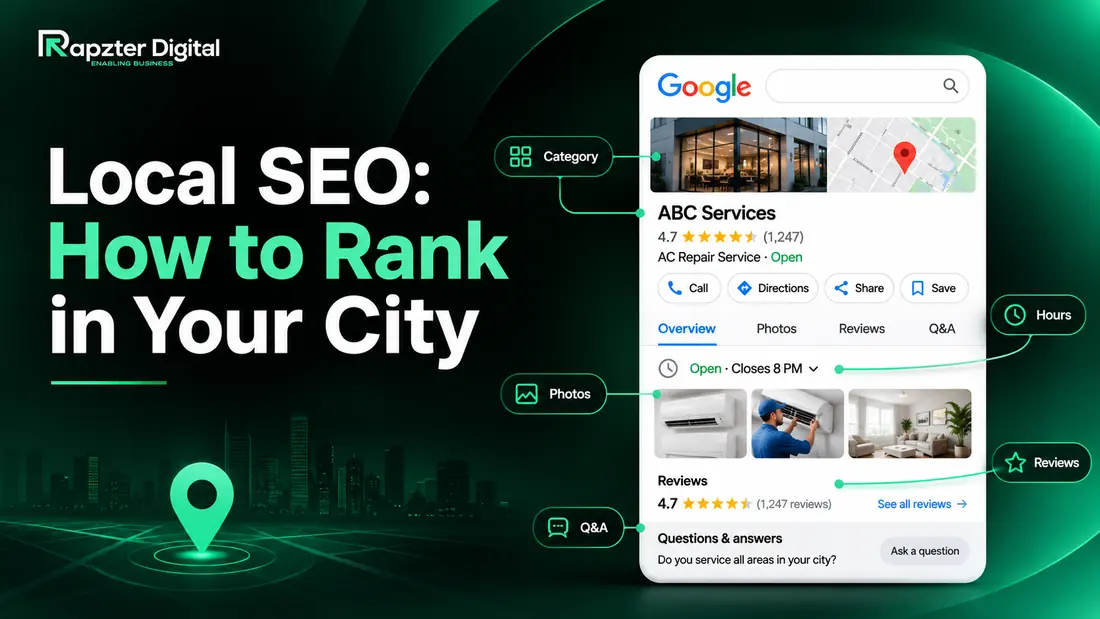
When someone searches "physiotherapist near me" or "CA in Andheri," Google shows a map with three businesses before any website. That map pack is where local SEO in India wins or loses customers.
Google says local results are based mainly on relevance, distance and prominence, and that there's no way to pay for a better local ranking. So the work is in your profile and your reputation.
Your local SEO checklist
- Claim and verify your Google Business Profile. Pick the most accurate primary category, add services, hours, photos and holiday hours.
- Keep NAP consistent. Your business name, address and phone number should match exactly on your website, profile and every listing.
- Ask for reviews regularly. Request them after a good experience, and reply to every review, including the negative ones.
- Create city-specific landing pages if you serve several areas, with genuinely local details such as landmarks, service areas and local case examples. Don't copy one page and swap the city name.
- Use local keywords in titles and headings, like "AC repair in Navi Mumbai."
- List on Indian directories that matter to your buyers: Justdial and Sulekha for local services, IndiaMART for B2B suppliers and manufacturers.
- Add relevant local citations from chambers of commerce, trade associations and city business listings.
Do You Need Regional Language SEO?
Maybe, but only if your customers actually search in that language. Google rolled out AI Mode in Hindi in September 2025, a clear signal that regional-language search is growing. A Nagpur coaching institute or a Rajasthan agri-equipment dealer may find many buyers searching in Hindi or Marathi.
Before you translate anything, check the demand and the setup.
- Check real search demand. Research keywords in the target language and in Hinglish ("sasta flat Pune mein").
- Write, don't machine-translate. A native speaker should create or edit the content so it reads naturally.
- Set up hreflang tags so Google shows the right language version to the right user. Google explains this in its guide to localised versions.
If your buyers are English-speaking B2B decision-makers, regional pages may simply split your effort. Start where your audience is.
SEO vs PPC (Google Ads): Which Should You Choose?
The honest answer for most businesses is both, at different times.
SEO and PPC side by side
| Factor | SEO | PPC (Google Ads) |
|---|---|---|
| Cost | Ongoing investment in content and fixes, no fee per click | You pay for every click |
| Time to results | Usually months | Can start within days of launch |
| Longevity | Rankings can keep bringing traffic for months | Traffic stops when the budget stops |
| Traffic | Builds steadily over time | Instant, but limited by budget |
| Best use case | Long-term growth and lower acquisition cost | Launches, offers, seasonal demand, testing keywords |
Example (illustrative): A new pet-grooming studio in Gurugram runs Google Ads for "dog grooming near me" in its first month to get bookings. Meanwhile, it builds a Google Business Profile, service pages and reviews. By month six, organic and map traffic carry more of the load, so ad spend can drop.
- Choose Google Ads when you need leads this month.
- Choose SEO when you want steady enquiries for years.
- Use both when ads can test which keywords convert while SEO builds rankings for them.
How Long Does SEO Take to Show Results?
Most businesses start seeing meaningful movement in three to six months. That matches Rapzter's own guidance: ranking for competitive keywords usually takes three to six months, while technical fixes can show results within weeks.
What to expect from SEO, by period
| Period | What businesses can expect |
|---|---|
| Months 1 to 3 | Audit, technical fixes, keyword mapping and first content. Early gains in impressions. |
| Months 4 to 6 | More content published, keywords moving up, visibility and clicks improving. |
| Months 6 to 12 | Stronger rankings, steady traffic growth and a growing share of organic leads. |
What speeds results up: a technically healthy site, a clear local focus, regular content and genuine reviews.
What slows them down: a brand-new domain, a crowded national category, past spammy links or a site rebuild that breaks old URLs.
Actual results depend on your competition, your website's current condition, your industry and how consistently you invest. Anyone who guarantees page one rankings in a fixed time isn't being straight with you.
How Much Does SEO Cost in India?
SEO in India is usually billed as a monthly retainer, and the price depends on the number of pages, keywords, cities and the amount of content and link building included.
Be careful with very cheap packages. They often rely on low-quality links that can hurt you later. Treat the ranges below as indicative. The right fee still depends on the pages, cities and competitive set.
Indicative monthly SEO ranges in India
| Business type | Typical scope | Indicative monthly range |
|---|---|---|
| Local business, single city | GBP, local pages, basic on-page | ₹10,000 to ₹30,000 |
| Growing SME or startup | Technical SEO, content, some link building | ₹30,000 to ₹75,000 |
| Ecommerce, multi-city or highly competitive | Large sites, heavy content and digital PR | ₹75,000 and above |
Which SEO Metrics Should You Track?
Any good SEO guide for businesses should push you past rankings to numbers that connect to real business results. Most of these are free in Google Search Console and Google Analytics 4.
SEO metrics worth a monthly review
| Metric | Where to find it | What it tells you |
|---|---|---|
| Impressions | Search Console | How often you appear in search |
| Clicks | Search Console | How many people chose your result |
| Keyword rankings | Search Console, rank trackers | Where you stand for target keywords |
| Organic traffic | GA4 | Visitors coming from search |
| Organic leads | GA4 key events, CRM | Form fills, calls and WhatsApp chats from search |
| Conversions | GA4, CRM | Enquiries that became paying customers |
| AI citations and brand mentions | Manual checks in AI tools, brand monitoring | Whether AI answers mention or cite you |
Review these monthly. If impressions rise but clicks don't, improve your titles. If traffic rises but leads don't, fix the page and its call to action.
Common SEO Mistakes to Avoid
Most SEO problems aren't complicated. They're small mistakes repeated across many pages. Here are five worth fixing first.
Targeting only big, generic keywords
Ranking for "furniture" is unrealistic for a local store. Go after specific long-tail phrases like "solid wood sofa in Bengaluru."
Ignoring mobile speed
A beautiful site that loads slowly on 4G loses buyers. Test your top pages in PageSpeed Insights and compress heavy images first.
Publishing thin or copied content
Five 300-word blogs rarely beat one genuinely useful page. Answer the full question, with real examples and prices.
Buying cheap backlinks
Bulk link packages can trigger penalties. Earn links through PR, partnerships and useful data.
Quitting after two months
SEO compounds slowly, then quickly. Commit to at least six months and review progress monthly.
DIY SEO vs Hiring an SEO Agency
You can do a lot of SEO yourself. The real question is whether you have the time and skills to do it consistently.
Doing SEO yourself or hiring an agency
| DIY SEO | SEO agency | |
|---|---|---|
| Best for | Small local businesses, early-stage startups | Growing businesses, competitive markets, large sites |
| Time needed | 5 to 10 hours a week, ongoing | A few hours a month for reviews and approvals |
| Skills needed | Willingness to learn tools, write and test | Specialists in technical SEO, content and outreach |
| Cost | Mostly your time, plus optional tools | Monthly retainer |
| Main risk | Slow progress or costly technical errors | Choosing an agency that overpromises |
What you can handle yourself: setting up Google Business Profile, collecting reviews, writing service pages, basic on-page fixes and tracking Search Console.
When professional help makes sense: your site has technical issues you can't diagnose, competitors are well ahead, you're planning a redesign or migration, or SEO keeps slipping down your to-do list.
If you hire, ask for a clear plan, monthly reporting and honest timelines. Walk away from anyone who guarantees the number one spot.
If you'd rather have a team handle it, you can see how Rapzter approaches SEO, covering technical fixes, content, local SEO and AI search readiness. Either way, use this SEO guide for businesses as your checklist.
Conclusion: Build a Strong SEO Strategy for Your Business
SEO is how customers find you at the exact moment they're ready to buy. Start with an audit, fix the technical basics, map keywords to pages, build helpful content and strengthen your local presence. Then measure what matters and keep going.
Use this SEO guide for businesses as your roadmap, and revisit it each quarter as your site grows.
Not sure where your website stands today? Get a free SEO audit from Rapzter and find out what's holding your rankings back.
Questions
People also ask
Is SEO worth it for small businesses in India?
Yes, for most small businesses. Local customers search Google before visiting or calling, and SEO helps you appear in those searches without paying for each click. A well-optimised Google Business Profile and a few strong service pages can bring steady enquiries. The return builds over months, so treat it as a long-term investment.
How long does SEO take to work?
Most businesses see meaningful movement in three to six months, with stronger results between six and twelve months. Technical fixes can show impact within weeks. The exact timeline depends on your competition, website condition, industry and how consistently you publish and improve. No honest provider can guarantee a fixed ranking date.
Can I do SEO myself?
Yes. Many small business owners handle the basics themselves: Google Business Profile, reviews, page titles, helpful service pages and Search Console tracking. It takes time and patience. As competition grows, or if your site has technical problems, a specialist can save you months of trial and error and avoid costly mistakes.
What is the difference between SEO and Google Ads?
SEO earns you unpaid positions in search results through better content, technical health and authority. Google Ads places paid listings at the top, and you pay every time someone clicks. Ads bring traffic quickly but stop when the budget ends. SEO takes longer but keeps bringing visitors without paying per click.
Does SEO still work with AI search tools like ChatGPT?
Yes. AI tools such as Google AI Overviews and ChatGPT draw on web content, so a well-structured, accurate and trusted website improves your chances of being cited. Google says no special optimisation is needed for its AI features beyond normal SEO best practice. Inclusion in AI answers is never guaranteed.
What is the difference between local SEO and regular SEO?
Local SEO helps you appear for searches in a specific area, such as "dentist in Powai," mainly through Google Business Profile, reviews and local listings. Regular SEO targets wider searches, often across India or globally, through content, technical improvements and backlinks. Many businesses need both, depending on where their customers are.
Want this kind of thinking on the account?
Tell us the problem. We'll tell you how we'd solve it.